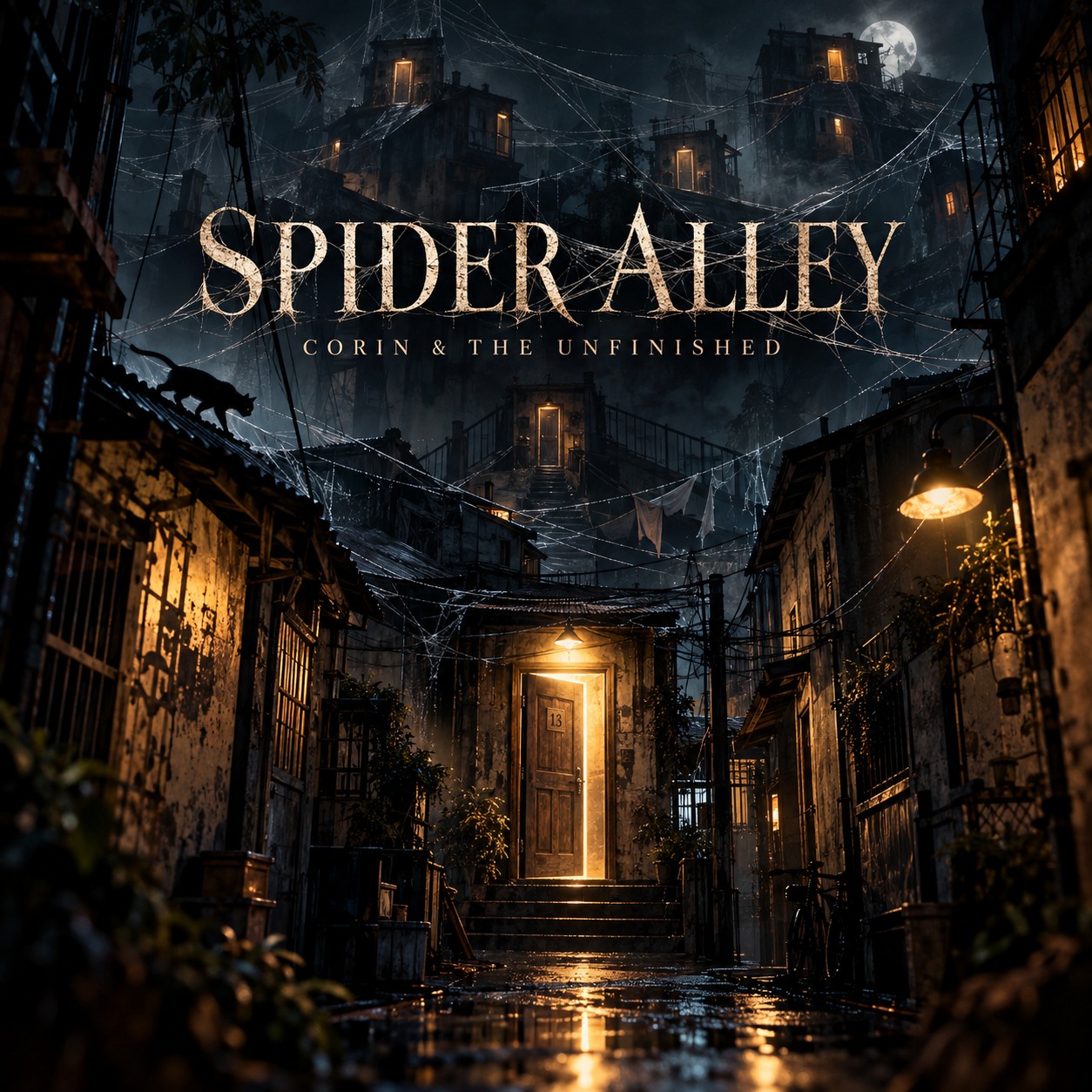
Song story
Another one of the whispered origins of Spider Alley.
Lyrics
Subtitles readyIn the beginning, there was no Alley, only a room with a door. Nobody remembers the building, or the number that it wore. Third floor, or maybe the fourth, a door at the end of the hall, till one night the hallway just stopped, like it never had a door at all. A week later, two streets away, in a kitchen, a new door stood, the very same number upon it, nailed crooked into the wood. She left it shut and went to bed, by morning there was a thread instead, out her window, thin as fishing line, across the rooftops, pulled tight and fine, over gutters, over gates and tin, back to the hall where the room had been. Every time the room moves on, it leaves a thread behind, one more line to lead it home, one more knot it can’t untie. And year by year it came around to anyone who’d lost what can’t be found: a son, a name, a reason to stay. They’d step inside, and walk away lighter or heavier, changed somehow, and one more thread would hang there now. In time the threads sank out of sight, but the town grew up along them anyway. Every path the room had pulled turned into a street, an alleyway. Houses crowded where the strands had crossed, every corner bent the way the line was spun. Walk these streets and you’ll lose the map, end up somewhere you can’t name, but your feet will know the turns by heart, like you’d been here before you came. Then one night an old woman climbed the stairs up to her roof, looked down at the streets below, and said out loud the truth: “It looks like a spider’s web.” Spider Alley, that’s how it got its name, a room that moves and never moves the same. It leaves a thread behind it every time, pulling home along a single line. Every street is a place the room once stood. Every crossing, two stories that touched. And somewhere in the middle, it’s still pulling, waiting to see who walks back.